KIERKEGAARD, SØREN.
Herman H. J. Lynge & Søn A/S
lyn62266
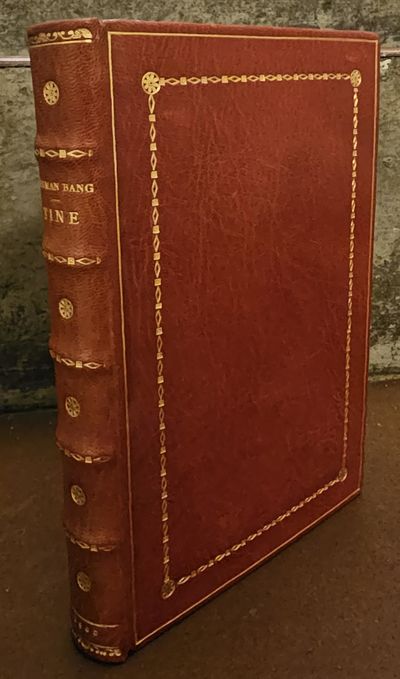
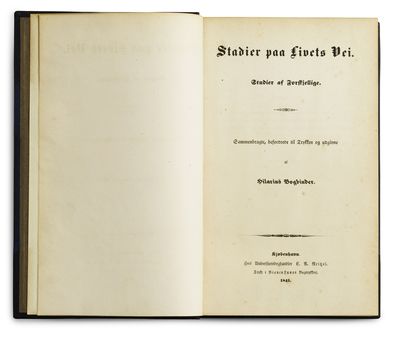
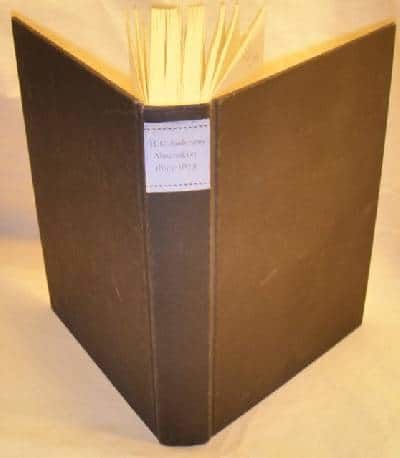
Kjøbenhavn, Reitzel, 1845. Large 8vo. (8), 383 pp. An extraordinary copy printed on very heavy vellum-paper and bound in the mid-20th century in an elegant black half Morocco binding with single gilt lines to boards; double gilt lines and Gothic gilt lettering to spine (bound by Agnete With). Top edge gilt. A bit of brownspotting throughout. With the bookplate of Henning Kehler to inside of front board and with neat pencil annotations to back free end-paper describing the history of the copy. With a handwritten correction on p. 47. Kierkegaard’s own copy of the pivotal sequel to his main work Either-Or, one of two copies printed on special paper, with Kierkegaard’s own handwritten correction on p. 47. In Either-Or, Kierkegaard had presented the first two stages, the aesthetic and the ethical. In Stages on Life’s Way, he continues his work on these stages and moves on to present also the religious stage, which occupies approximately two thirds of the work. The religious stage is that in which man attains a personal relationship with God and that in which man only truly begins to exist, the aesthetic and ethical stages being inadequate. It is in this foundational work, in the religious stage, that Kierkegaard first properly describes what is now known as the “Leap of Faith” (in fact a “leap to faith”), namely the leap that involves willing and belief instead of reason and knowledge, the leap that you take in order to connect to God and which requires that which Kierkegaard calls “the suspension of the ethical”. Undoubtedly among Kierkegaard’s most brilliant literary achievements, Stages on Life’s Way is written in the form of different viewpoints of Kierkegaard’s many pseudonymous characters. We have both Hilarius Bookbinder, who by chance has come into possession of the documents presented in the work and has prepared them for printing. We have the famous banquet scene, which mirrors Plato’s Symposium, described by William Afham, and in which the three aesthetics participate: Johannes the Seducer, Victor Eremita, and Constatin Constantius. We have Judge William’s discourse in praise of marriage, and we have the diary, discovered by Frater Taciturnus, of a young man, who was deeply in love but felt compelled to break off his engagement. This story in form of a diary is the closest one comes to a description of Kierkegaard’s own love story, his relationship to Regine. The diary describes an engagement that has lasted for six months; it alternates between the morning notes that recall the engagement and the midnight notes that put it all in perspective. The work closes with a letter to the reader from Taciturnus on the three “existence-spheres” represented by the three parts of the book. Stages on Life’s Way is one of Kierkegaard’s most important works. Not only does it sum up and explain some of the most important themes of Kierkegaard’s previous works, utilizing the characters and pseudonymous authors of the earlier works to do so; it goes beyond these foundational themes, introduces the religious stage, and points to the further development of the central themes in Kierkegaard’s philosophy, most of which are only fully developed in Concluding Unscientific Postscript. Written under a pseudonym and without Kierkegaard’s name appearing as publisher or indeed anything else, he was unable to give away presentation-copies of the work (due to his own rigid set of rules for his presentation-copies). Thus, not a single presentation copy of the work exists. A single copy of the book was in the auction catalogue of his book collection after his death. In Rohde’s edition of the auction-record, this copy and its recent faith is thoroughly described. Like Repetition, Prefaces, and his other seven pseudonymous works, Stages on Life’s Way was printed in two copies each on vellum-paper and bound in special bindings, one for Regine, one for Kierkegaard himself. 24 years ago, three of these books surfaced, at an auction in 2002, namely Either-Or, Repetition, and Prefaces, all being the copies Kierkegaard had bound for Regine. Before that, only one single copy of one of these eight titles for Kierkegaard himself or for Regine were known (namely Kierkegaard’s own copy of Either-Or, which is in the Danish Royal Library). Seven of the books, Kierkegaard’s own copies, were listed in the auction catalogue after his death, but apart from the mentioned copy of Either-Or in the Royal Library, the others had not been found. Kierkegaard’s wildly famous love story and failed engagement to Regine Olsen plays a pivotal role throughout Kierkegaard’s entire life and work. It all begins in 1837, when Kierkegaard meets the lovely young girl Regine Olsen at a visit to the widowed Cathrine Rørdam. Three years later, in September 1840, after having corresponded frequently with her and visited her on numerous occasions, Kierkegaard decides to ask for her hand in marriage. She and her family accept, but the following day, Kierkegaard regrets his decision and ends up finally breaking off the engagement in October 1841. Disregarding the scandal, the heartbreak (his own included), and the numerous pleas from family members and friends alike, Kierkegaard’s tortured soul, still searching for God and for the meaning of faith, cannot continue living with the promise of marriage. Later the same month, he flees Copenhagen and the scandal surrounding the broken engagement. He leaves for Berlin, the first of his four stays there, clearly tortured by his decision, but also intent on not being able to go through with the engagement. As is evident from his posthumously published Papers, Kierkegaard’s only way out of the relationship was to play a charming, but cold, villain, a charlatan, not betraying his inner thoughts and feelings. Despite the brevity of the engagement, it has gone down in history as one of the most significant in the entire history of modern thought. It is a real-life Werther-story with the father of Existentialism as the main character, thus with the dumbfounding existentialist outcome that no-one could have foreseen. This exceedingly famous and difficult engagement became the introduction to one of the most influential authorships in the last two centuries. “She was the reason for my authorship”, Kierkegaard writes in his Papers, and there is no doubt that several of his most significant works are born out of the relationship with Regine – and its ending. It is during his stay in Berlin, his first of four altogether, right after the rupture of the engagement, that he begins writing Either-Or, parts of which can be read as an almost autobiographical rendering of his failed engagement. After a couple of years, Regine got engaged to someone else, whom she married in 1847. But as is well known, Kierkegaard never married, and the impact of his engagement to Regine and what it made him understand – about himself, about religion, faith, the inner workings of the philosopher and the poet –, never lost its significance. It is evident from the many drafts of a letter that he sent to Regine, through her husband, in 1849 (which was returned to him, unopened) that he had never lain the matter to rest and that the relationship with Regine was still very much alive. He also states in his Notebook 15 from 1849 “By the way, it is certainly the case that my relationship with her has been a very close, present study for me of what faith is. For I know better in this relationship how it is apparently the exact opposite of the foundational. That I have lasted in this relationship has been useful for me in relating to God as a believer.” In his Notebook 15, also known as My Relationship with Her, from 1849, Kierkegaard describes how, when he finally broke off the engagement and she tried to get him to stay, she had told him “that she would thank me her entire life for being allowed to stay with me, even if she were to live in a little cupboard” (SKS No. 16: 6). Thus, Kierkegaard had a little cupboard made, with no shelves in it. Here, he kept “everything that reminds me of her and will remind me of her. There is also a copy of the pseudonyms (i.e. the works that he wrote under a pseudonym); of these, there were always only two copies on vellum-paper, one for her and one for me.” (SKS: Not. 15:6.). In all, Kierkegaard wrote eight pseudonymous books, Stages on Life’s Way being one of them, all of which were evidently printed in two copies each on vellum-paper and bound in special bindings, one for Regine, one for Kierkegaard himself. This splendid copy, which is one of two specially produced copies, being Kierkegaard’s own copy, with his own correction (deleting “ikke” – i.e. “not” on p. 47), is nr. 2136 in the auction catalogue of Kierkegaard’s books sold after his death. In Rohde’s official edition of the auction catalogue, there is a lengthy note on the present copy documenting the more recent history of the copy:“Now: Mogens Müllertz, Copenhagen. Copy on vellum-paper. S.K.,’s own handwritten correction of the printing error “not” on p. 47, cf Papers XI I, p. 36. The previous owner, the author Henning Kehler, has let the book, which was originally in half calf, rebind in black half calf by Agnete With and has pasted his book plate on the inside of the front board. In 1952, Henning Kehler gave the book as a Christmas present to Mogens Müllertz; in an accompanying letter Kehler writes, among other things: “even though the present book is my best and dearest, I still want you to have it. I know of no-one else to whom I would rather dispense with it.” In an article “About printing errors”, Berlingske Aftenavis 9.11.1963, Kehler touches upon this book gift: “Being a writer I am naturally hardened when it comes to printing errors, no book and no newspaper article is without errors. Søren Kierkegaard, who could even pay others – eg. Israel Levin – to proofread mentions in his Papers a printing error in “Stages on Life’s Way”, which kept vexing him. It was a “not” that had fallen out. I once owned a copy of the book that had been placed in the palisander book cabinet for Regine, and in that copy, this “not” had been added in ink and in Kierkegaard’s handwriting. I gave the book to a book-mad collector – under false pretenses, alas.” – Identification of the copy uncertain.” (pp. 110-11).Although Kehler is mistaken in the correction being adding a “not” instead of deleting one, there is no doubt that this is the copy he is referring to. The sentence on p. 47, in which the correction occurs reads “Pro dii immortals what is a woman, when she is not in fashion, per deo obsecro what is she when she is not (this being the “not” that Kierkegaard has deleted here and was vexed about) in fashion”.This copy on very heavy paper – one of the two printed like this – is approximately 1/3 thicker than normal copies of the book.The pencil annotations on the back free end-paper bear witness to the previous owner’s frustration at Kehler for having tampered with the copy. After stating that this is Kierkegaard’s personal copy, one of two on vellum-paper and copy nr. 2136 from the auction catalogue, he continues: “The copy used to have all edges gilt, a few leaves still have remains of this. The edge has been shaved at the ruthless rebinding that Henning Kehler in his complete lack of understanding of what he possessed had done.” On Kehler’s bookplate, the same previous owner has noted in neat pencil-annotation “bibliophile vandal”.In spite of the frustration with this particular book having been rebound and not kept exactly as it was, this is still an utterly amazing copy of one of Kierkegaard’s most important works – hands down the best copy there is of the work. Namely Kierkegaard’s own, with his own correction, one of two printed on heavy paper, one for Regine, one for himself. We must be thankful that, despite the “vandalism” of the rebinding, the book is still here and identified as that same copy that Kierkegaard had made for himself. Himmelstrup 78.
Se hele beskrivelsen